
Views: 0 Author: Site Editor Publish Time: 2026-08-28 Origin: Site


For furniture manufacturers and procurement teams, sourcing hardware is a strict balancing act between unit economics and final product reliability. Every production run demands a precise alignment of cost, aesthetics, and structural integrity. The wrong choice in sofa legs can easily lead to severe margin erosion from unnecessary over-engineering. Conversely, under-engineering results in disastrous product failures, expensive returns, and negative reviews. Substandard materials compromise user safety and damage brand reputations quickly. Today’s consumers inspect furniture details closely. A beautifully upholstered piece loses all appeal if the base feels unstable.
This guide breaks down how to align material specifications, load-bearing requirements, and surface finishes across your diverse furniture lines. You will discover exactly how to evaluate different hardware tiers, ranging from cost-efficient mass production to bespoke luxury seating. We will show you how to select the proper metal gauge, geometric design, and plating for any target demographic. By understanding the underlying metallurgy and manufacturing tolerances involved, procurement teams can confidently negotiate with suppliers and guarantee consistent quality.
Material Alignment: Match hardware to retail tiers using Q235 iron for entry-level, zinc alloy for mid-range, and specialized stainless or brass for premium collections.
Load-Bearing Realities: A leg’s failure point is rarely the shaft; it is almost always the weld quality at the mounting plate or the gauge of the metal used.
Finish Tolerances: Electroplating and powder-coating standards dictate rust resistance and perceived value, requiring distinct QA protocols based on market positioning.
Supplier Shortlisting: Auditing a supplier’s sample-to-bulk consistency and testing certifications is non-negotiable for enterprise rollouts.
Treating metal sofa legs for furniture as a pure commodity often leads to severely mismatched specifications. Hardware accounts for a very small fraction of your total Cost of Goods Sold (COGS). However, it disproportionately impacts consumer trust. Wobbly frames, scratched hardwood floors, and visible rust destroy perceived value instantly.
Success requires identifying exact structural requirements and aesthetic baselines. You must define the weight capacity per seat meticulously. You also need to establish finish longevity standards suited perfectly for your target demographic.
To properly frame your procurement strategy, assess both the tangible manufacturing metrics and the intangible consumer perceptions. Best practices dictate mapping your hardware budget directly to the expected warranty period of the furniture.
Analyze Consumer Usage: Determine if the furniture will face light residential use or heavy commercial traffic.
Establish Aesthetic Goals: Match the visual weight of the hardware to the upholstery style.
Define Tolerance Limits: Create strict dimensional tolerance guidelines before requesting factory quotes.
In practical implementation, minor upgrades make massive differences. Upgrading a leg tube from standard 1.2mm (18-gauge) to 1.5mm (16-gauge) wall thickness costs mere cents at scale. Yet, this small change significantly reduces the risk of structural deflection in heavy-use environments. A common mistake involves relying entirely on generic factory specifications. Always dictate your own wall thickness and mounting plate dimensions. Taking ownership of these specifications prevents suppliers from quietly downgrading materials during secondary production runs.
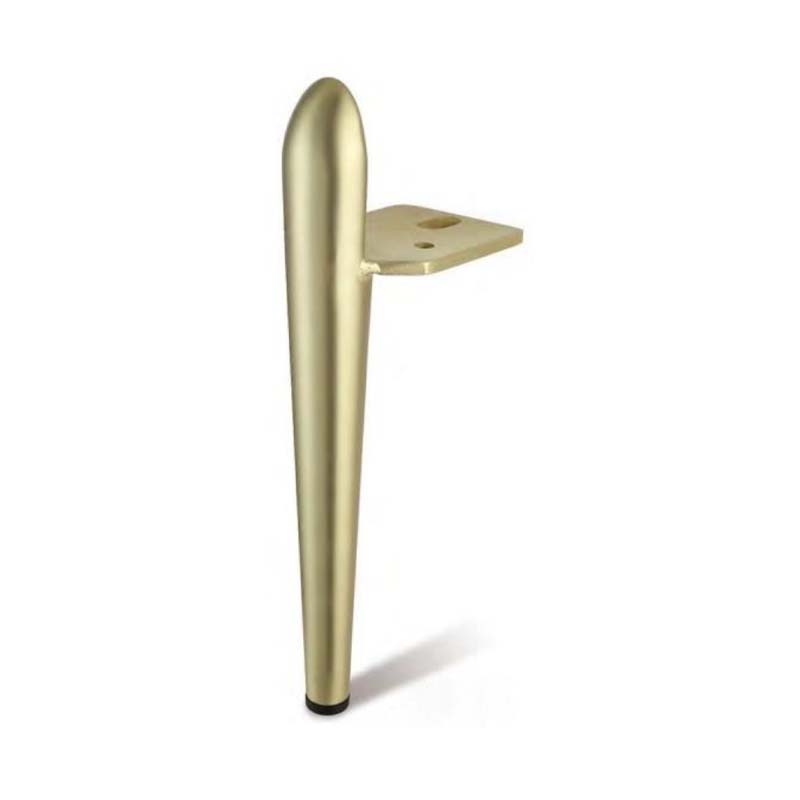
Entry-level furniture lines require strategies focused heavily on volume and cost efficiency. The strategic role here centers on maximizing profit margins and accelerating production speed. You must achieve these financial goals without ever sacrificing baseline safety and structural integrity.
Q235 iron sofa legs serve as the undisputed industry standard for mass-market furniture. They offer excellent weldability, dependable tensile strength, and incredibly low raw material costs.
Evaluation criteria for this tier include:
Finish Standards: Standard powder coating dominates this category. You must verify uniform application to prevent premature oxidation. The factory must properly degrease, acid wash, and phosphate the raw iron before baking the powder coat.
Design Constraints: Production lines primarily use straight tubes, basic stamped angles, or simple hairpin shapes. Complex geometries slow down automated welding and increase rejection rates.
Risk Factor Mitigation: Iron remains highly vulnerable to rust if the coating chips during transit. Strict shipping packaging protocols are absolutely required.
When shortlisting suppliers, logic dictates prioritizing automated capabilities. Look for partners operating automated robotic welding machines and continuous high-volume powder-coating lines. Automation removes human error from the equation. It ensures unit consistency across thousands of pieces, keeping your defect rate well below industry averages.
Mid-range furniture collections bridge a crucial gap in the retail market. They balance affordability alongside distinct design differentiation. Consumers shopping in this tier expect modern aesthetics without paying premium boutique prices.
zinc alloy sofa legs provide precise die-casting capabilities. This enables intricate shapes and ensures superior surface adhesion for high-end electroplating. Zinc possesses a lower melting point, allowing factories to inject it into highly complex molds with exceptional precision.
Evaluation criteria for mid-range components include:
Design Flexibility: Zinc die-casting perfectly suits angled profiles, organic curves, and mid-century modern aesthetic replication. It allows for integrated structural gussets hidden inside the leg geometry.
Finish Upgrades: Focus on high-quality electroplating. Options like polished chrome, matte black, and brushed nickel offer significantly better corrosion resistance than basic powder coats. They also provide a premium tactile feel.
Risk Factor Management: Die-casting porosity presents a major structural threat. Trapped air during the injection phase creates invisible hollow pockets inside the metal.
Suppliers must demonstrate strict temperature and pressure controls during casting. Poor controls create brittle internal structures prone to snapping under lateral weight. To avoid sudden failures, implement these specific quality assurance steps during your factory audits:
Request fracture test reports directly from the factory floor to verify core density.
Inspect cross-sections randomly for visible air pockets or granular inconsistencies.
Verify electroplating adhesion using industry-standard cross-hatch testing methods.
Hardware Sourcing Tiers and Material Specifications Chart
Retail Category | Primary Material | Typical Surface Finish | Key Quality Focus Area | Common Design Application |
|---|---|---|---|---|
Entry-Level | Q235 Iron | Standard Powder Coating | Weld consistency and paint uniformity | Straight tubes, basic angles |
Mid-Range | Zinc Alloy | Electroplating (Chrome/Nickel) | Casting density and corrosion resistance | Complex curves, angled profiles |
Premium | Stainless Steel / Solid Brass | PVD / Hand-Brushed / Polished | Flawless aesthetics and heavy gauge | Tapered luxury legs, bespoke shapes |
Premium furniture lines utilize hardware to elevate brand authority. High-end consumers view these components as architectural features rather than just functional parts. A luxury sofa demands hardware reflecting identical craftsmanship to the premium upholstery itself.
Materials for this tier include solid brass and high-grade stainless steel (304 or 316 series). We often see premium tapered sofa legs featuring flawless surface treatments in these luxury collections. Stainless steel provides immense tensile strength, while brass offers unmatched warmth and natural aging characteristics.
Evaluation criteria for premium hardware demand strict scrutiny:
Finish Quality: Utilize PVD (Physical Vapor Deposition) coatings, hand-brushed brass techniques, or mirror-polished stainless finishes. Zero visible weld marks are permitted. Artisans must meticulously polish every joint by hand.
Structural Engineering: Use solid casting or heavy-gauge tapering. Incorporate reinforced, oversized mounting plates to successfully support dense hardwood frames securely.
Risk Factor Reality: Prepare for high scrap rates during production. Zero-tolerance cosmetic standards mean minor scratches ruin entire batches. This inherently drives up the final unit cost.
You must require suppliers to operate dedicated premium QA lines. Segregating premium production prevents cross-contamination from mass-market abrasive dust. A common mistake is allowing a factory to run premium stainless steel parts on the same polishing wheels used for raw iron. This inevitably embeds rust-prone particles into the luxury finish.
Testing hardware rigorously ensures theoretical specifications survive real-world living rooms. Structural failures rarely happen gracefully; they often result in collapsed furniture and potential liability.
Load Capacity & Geometry: You must objectively assess straight versus angled load distribution. Angled legs naturally introduce intense lateral stress to the mounting point. This specific geometry requires thicker top plates and strategic gusseting for adequate reinforcement. A straight leg supports weight through direct vertical compression, whereas a splayed leg acts as a lever against the sofa frame.
Weld Integrity: Always evaluate full-seam welding against spot welding. Spot welding represents a common failure point identified in long-term consumer durability reviews. Full-seam welding distributes stress evenly across the entire joint, preventing metal fatigue over years of daily seating impact.
Floor Protection: Assess the integration of protective elements thoroughly. Look for factory-installed nylon glides, adjustable leveling feet, or high-density rubber pads. These additions prevent floor gouging and easily manage uneven surfaces. Relying on end-users to apply aftermarket felt pads often leads to complaints about scratched hardwood floors.
Salt Spray Testing: Demand transparent factory data regarding corrosion resistance. You should require 24-hour salt spray test compliance for standard dry climates. For coastal shipping destinations or humid environments, mandate strict 48-hour or 72-hour test compliance to ensure long-term finish stability.
Choosing a manufacturing partner dictates your entire product lifecycle. A thorough technical audit prevents catastrophic production delays and ensures scalable quality.
First, audit the spec sheet rigorously. Ensure the supplier provides exact tolerances for overall height, plate thickness, and hole diameter. Vague specifications lead to manufacturing drift over time. You should specify tolerance limits tightly to guarantee perfectly level seating.
Next, prioritize the sampling phase aggressively. Never skip pilot testing. You should mount physical samples directly onto production-grade sofa frames. Conduct localized weight testing and lateral drop testing to observe real stress points. Push the frame across a carpeted floor to simulate moving the furniture; this perfectly tests lateral weld strength.
Finally, demand complete supply chain transparency. Evaluate lead times accurately based on actual factory capacity, not optimistic sales promises. Observe whether they use advanced robotic welding arms during facility tours. Scrutinize their packaging methods closely. Suppliers must use individual bubble wrap or custom molded EPE foam to prevent metal-on-metal scratching during ocean transit. Furthermore, document the supplier’s defect resolution policies and replacement protocols clearly before signing initial purchase orders.
Analyze Current Defect Rates: Procurement teams should immediately review current return data and customer complaints regarding hardware instability, wobbling, or floor damage.
Upgrade Key Specifications: Initiate new sample requests focusing heavily on upgraded mounting plate thickness. A thicker plate drastically reduces leverage stress on wooden frames.
Align Finishes Strategically: Improve finish quality for your most profitable lines. Transitioning from basic powder coats to premium electroplating instantly boosts perceived consumer value and brand authority.
Enforce Testing Protocols: Require all suppliers to provide documented salt-spray and load-bearing test certificates for every new production run.
A: Residential furniture typically requires a baseline capacity of 200 to 250 lbs per leg. This adequately supports normal household usage. Commercial and hospitality environments face heavier, continuous stress. Therefore, commercial specifications mandate a minimum of 300 lbs per leg. Upgrading metal thickness ensures commercial frames pass rigorous safety compliance tests.
A: Yes. The mounting plate size determines load distribution across the wooden frame. A strong metal shaft will still fail if a small plate concentrates stress into a weak wood joint. Wider mounting plates prevent screw tear-out and stabilize lateral movement, regardless of the core leg strength.
A: While technically feasible, electroplating Q235 iron is rarely cost-effective or visually ideal. Iron surfaces require extensive polishing to achieve the smoothness needed for high-quality electroplating. Manufacturers generally prefer zinc alloy or stainless steel for electroplating. These materials naturally offer superior surface smoothness and better chemical adhesion properties.


