
Views: 0 Author: Site Editor Publish Time: 2026-07-01 Origin: Site


Furniture brands and industrial designers constantly face a demanding challenge. They must bridge the gap between distinct design aesthetics and strict mass production realities. You might sketch a beautiful concept for an upcoming collection. However, turning it into thousands of identical units introduces significant hurdles. Procurement managers must consider heavy tooling costs, load-bearing compliance, and batch consistency. Choosing the wrong design or material can delay launches and drain budgets. This guide clarifies which custom furniture leg styles transition best from prototype to bulk OEM manufacturing. You will discover the structural trade-offs behind popular profiles. We will also show you how to evaluate a supplier’s production capabilities before you commit. By understanding these manufacturing constraints upfront, you can scale your furniture collections successfully and profitably.
Almost any leg style can be customized, but complex geometries (like extreme tapers or deep angles) require specific tooling and material choices (e.g., die-cast metal vs. extruded aluminum).
Popular high-volume OEM styles include tapered, triangle, Y-shaped, and V-shaped profiles, each presenting unique load-distribution characteristics.
Successful OEM partnerships depend on validating a supplier’s sample-making process, tooling cost transparency, and surface finish consistency before committing to Minimum Order Quantities (MOQs).
Specifying load-bearing requirements upfront prevents costly redesigns, especially for minimalist Italian-style legs that require high-tensile materials.
Selecting the right leg profile requires balancing your aesthetic goals with manufacturing viability. Different shapes demand entirely different production methods. We categorize these highly requested custom furniture leg styles based on their scalability and structural performance.
Designers frequently rely on tapered sofa legs for Mid-Century Modern and contemporary transitions. Their wider top gradually narrows toward the floor. This profile offers a timeless, elegant silhouette. It feels visually light but remains structurally sound.
From an OEM reality perspective, this style is highly scalable. Manufacturers easily produce them via wood turning or metal pipe swaging. Metal swaging involves feeding a steel tube into a die. The machine rapidly compresses the metal into a smooth taper. This process requires low tooling costs. It also guarantees a high production yield. You rarely face structural defects during mass production. They remain a top choice for cost-effective scaling.
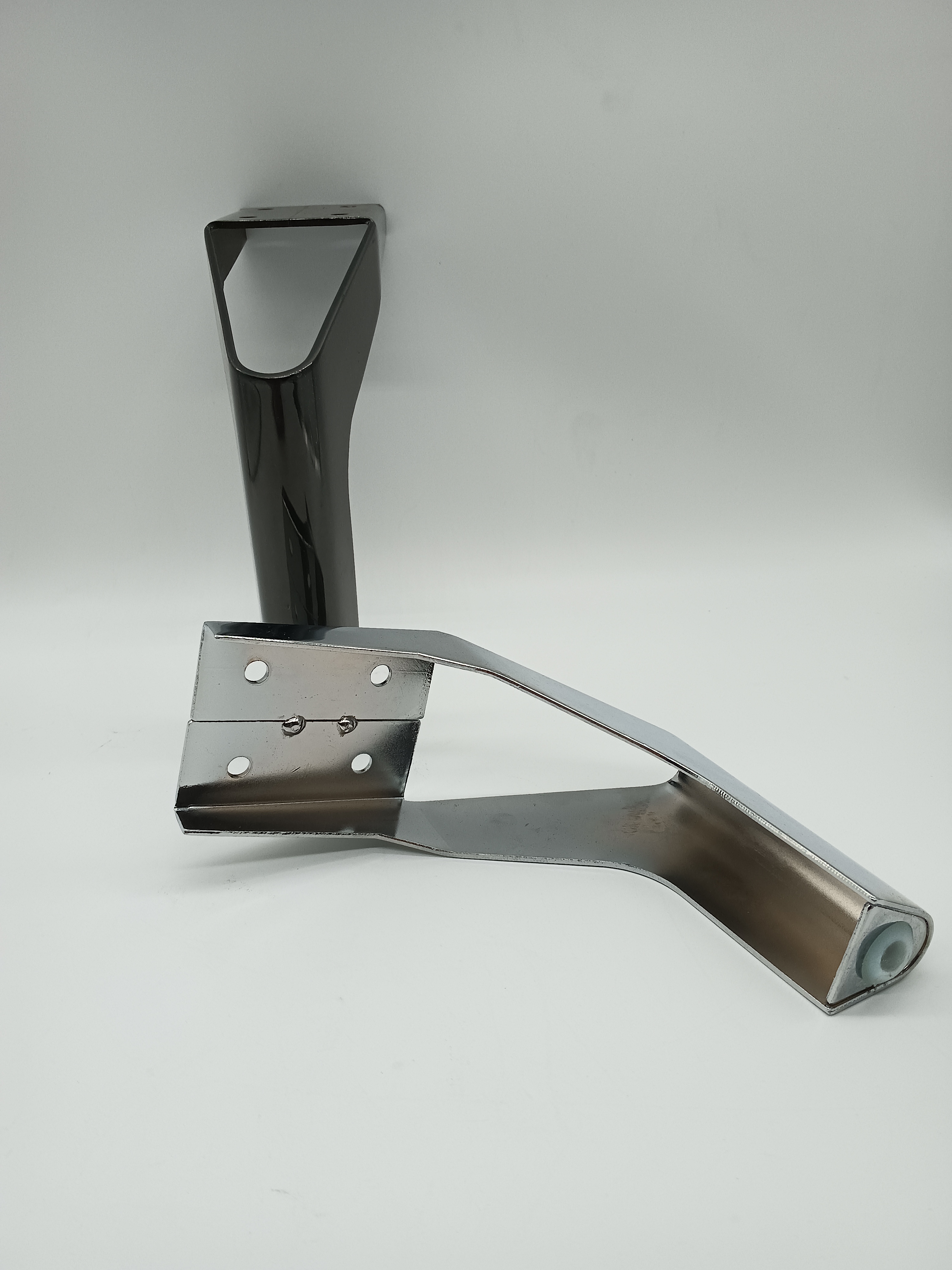
Heavy modular sofas and large storage cabinets need substantial support. triangle sofa legs offer a low-profile, geometric solution. They distribute heavy downward forces evenly across a broader floor area. Similarly, designers specify V-shaped furniture feet for heavy credenzas. Their angled stance provides exceptional lateral stability.
Producing these angled geometries requires precise sheet metal stamping. Factories must use automated robotic welding at the inner seams. This ensures the sharp corner angles do not compromise structural integrity. Furthermore, their wide top plates make them excellent for flat-packing. Consumers can attach them easily using standard pre-drilled holes. You must ensure your supplier polishes the welded seams completely flat before powder coating.
Modern architectural collections often feature visually distinct components. Y-shaped sofa legs create a stunning, lightweight aesthetic. They branch out elegantly, offering clear branding opportunities. They elevate the perceived value of luxury seating.
This design usually requires high-pressure die-casting. Manufacturers melt zinc or aluminum alloys and inject them into custom steel molds. This achieves a perfectly seamless joint where the "Y" branches. It eliminates weak weld points. You will face a higher initial tooling cost for the complex mold. However, die-casting delivers an excellent per-unit cost at high volumes. It also allows for intricate, organic detailing.
Premium modern furniture frequently utilizes ultra-minimalist designs. Italian-style sofa legs feature very slim, delicate profiles. Brands often request premium finishes like brushed brass, polished chrome, or matte black. They make heavy sofas appear as if they are floating.
This narrow footprint presents a strict OEM engineering challenge. The slender profile requires high-grade solid steel or reinforced alloys. Lesser materials will bend or snap under commercial load ratings. Strict quality control is absolutely necessary. The factory must execute flawless surface polishing prior to electroplating. Any minor surface scratch becomes highly visible under a glossy chrome finish.
Matching your chosen leg style to the correct material dictates the product's lifespan. An elegant design fails if it cannot support a three-seater sofa. You must establish strong decision frameworks regarding load-bearing dynamics and material properties.
How you angle a leg drastically affects its weight distribution. Vertical legs transfer weight directly down into the floor. Angled legs, however, create significant lateral stress on the top mounting plates. If you design a sharply angled leg, you must reinforce the welding at the connection plate. Otherwise, the leg might buckle under shifting human weight.
Choosing the right core material is equally important. We summarize the standard OEM material options in the structural comparison matrix below.
Material Selection Matrices
Material Type | Best Suited For | Load Rating Profile | OEM Tooling Cost |
|---|---|---|---|
Solid Steel | Heavy-duty applications, commercial seating, ultra-slim profiles. | Exceptional. Withstands high static and drop loads. | Low to Medium (Stamping/Welding). |
Extruded Aluminum | Complex linear shapes, outdoor furniture, corrosion resistance. | Moderate to High. Requires thicker walls for heavy items. | Medium (Extrusion Dies). |
Die-Cast Zinc Alloy | Intricate 3D geometries, organic curves, seamless branching. | Moderate. Ideal for residential sofas and cabinets. | High (Injection Molds). |
Finally, buyers must prioritize structural compliance and testing. You should specify commercial testing standards during your initial Request for Quote (RFQ). Widely accepted standards include BIFMA for North America or SGS certifications globally. Do not assume a factory tests for load capacity automatically. You must require them to perform static load testing and drop testing. This ensures your custom leg will not fail when a heavy user drops onto the furniture.
A reliable manufacturing partner utilizes a highly structured customization process. Transparency builds trust. You should understand the exact steps a factory takes to transform your sketch into thousands of physical units.
Phase 1: CAD & Feasibility Review. The factory engineers translate your 2D client sketches into detailed 3D CAD models. They must identify potential weak points immediately. For example, they might notice the wall thickness is too thin for successful electroplating. They will suggest thickening specific areas to prevent structural failure.
Phase 2: Tooling & Molds. Once you approve the CAD design, the factory creates the necessary tooling. You must clarify who owns the mold in your contract. Standard lead times for die creation range from 15 to 30 days. Many factories offer mold amortization agreements. They might refund your tooling fee once your bulk orders surpass a specific quantity.
Phase 3: Prototyping & Golden Sample. The factory produces a pre-production sample. We call this the "Golden Sample." This step is absolutely critical. You use it to verify finish quality, thread tolerances, and exact dimensions. You must test this sample on your actual furniture frame. Never approve bulk production without physically signing off on the Golden Sample.
Phase 4: Bulk Production & QC. After sample approval, the factory initiates mass production. They implement automated processes like CNC machining and robotic welding. This automation ensures unit number 1,000 remains perfectly identical to your approved Golden Sample. They also conduct random batch inspections before final packaging.
Procuring custom hardware carries inherent risks. Many buyers learn hard lessons after receiving defective shipments. You can avoid costly mistakes by recognizing these experience-driven insights.
Overlooking Finish Consistency: Color variations frequently happen between different production batches. Minor temperature fluctuations inside powder coating ovens alter the final shade. You must set acceptable tolerance ranges. Provide physical color swatches and require the factory to stay within a specific color delta.
Hidden Tooling Costs: Unreliable suppliers sometimes quote an artificially low per-unit price to win your business. Later, they embed exorbitant, non-refundable tooling fees into the final invoice. You must demand itemized quotes upfront. Separate the unit price clearly from the mold and setup fees.
Standardized vs. Custom Mounting Plates: Designing a highly custom leg is exciting. However, failing to standardize the mounting plate creates massive assembly line bottlenecks. If the hole patterns do not match your existing wooden frames, your assembly team will waste hours re-drilling. Always design your custom legs to fit standard, pre-existing mounting templates.
Ignoring Packaging Requirements: Heavy metal legs easily scratch each other during ocean transit. You must specify individual bubble wrapping and sturdy corrugated carton requirements. Metal rubbing against metal ruins premium finishes instantly.
You ensure a smooth procurement phase by providing excellent documentation. Ambiguous requests lead to wildly varying price quotes. Actionable communication sets the foundation for a successful partnership.
First, provide comprehensive specifications. Do not just send a rough drawing. You must include target dimensions, exact material preferences, and weight capacity requirements. Mention specific environmental use-cases. If the legs will sit in high humidity environments, specify strict rust-proofing treatments. Outdoor furniture requires specialized outdoor-grade powder coating to prevent rapid corrosion.
Second, define your Minimum Order Quantities (MOQs) and target lead times. Align your design complexity with your viable order volumes. Complex custom shapes generally require higher MOQs. Factories need large runs to offset the extensive machine setup times. Be realistic about your volume projections when negotiating prices.
Finally, request the right documentation upfront. Ask potential suppliers for raw material certificates. If you specify metal finishes, demand recent salt-spray test reports. These reports prove the finish can withstand environmental stress without peeling. Additionally, negotiate clear structural warranty terms before you place your initial deposit.
Customizing furniture leg styles for OEM is not just about aesthetics; it is a rigorous engineering exercise. You must carefully balance your creative design with tooling feasibility and load-bearing realities. Every angle and material choice impacts the final unit cost and product safety.
The right OEM partner will not simply say "yes" to a flawed design. They will proactively suggest minor modifications to improve scalability, reduce material waste, and increase overall durability. Their expertise protects your brand reputation.
Do not wait until the last minute to evaluate manufacturing constraints. Encourage your design team to send CAD drawings or initial concepts to a trusted supplier for a technical feasibility review and initial quote today.
A: MOQs vary heavily based on the manufacturing method. Simple CNC turning or metal stamping usually requires 500 to 1,000 pieces. However, complex die-casting (which involves melting metal into custom molds) often demands an MOQ of 2,000 to 3,000 pieces to offset high machine setup costs.
A: Developing a new custom mold typically takes 3 to 5 weeks. This timeline depends on design complexity. Simple stamping dies finish quickly. Intricate injection molds for organic shapes take longer due to detailed CNC machining and mandatory pre-testing adjustments.
A: Yes. Customizing finishes on standard shapes is a highly cost-effective strategy. You avoid new tooling costs entirely. Factories offer various surface treatments, including powder coating, anodizing, and electroplating. You can easily request custom colors, matte textures, or premium metallic platings.
A: Industry standard dictates that if you pay the full tooling fee, you own the mold and the intellectual property (IP). The factory simply stores it for your future orders. Always include a clear tooling ownership clause in your manufacturing agreement to build trust and protect your designs.


